
Insights
Border measures in Türkiye: our article in The Trademark Lawyer, Issue 4 2026
Asım Okat's practical guide to customs recordation, the 10-business-day detention window and power-of-attorney formalities for international trademark owners, now published in The Trademark Lawyer. Read it as a PDF.
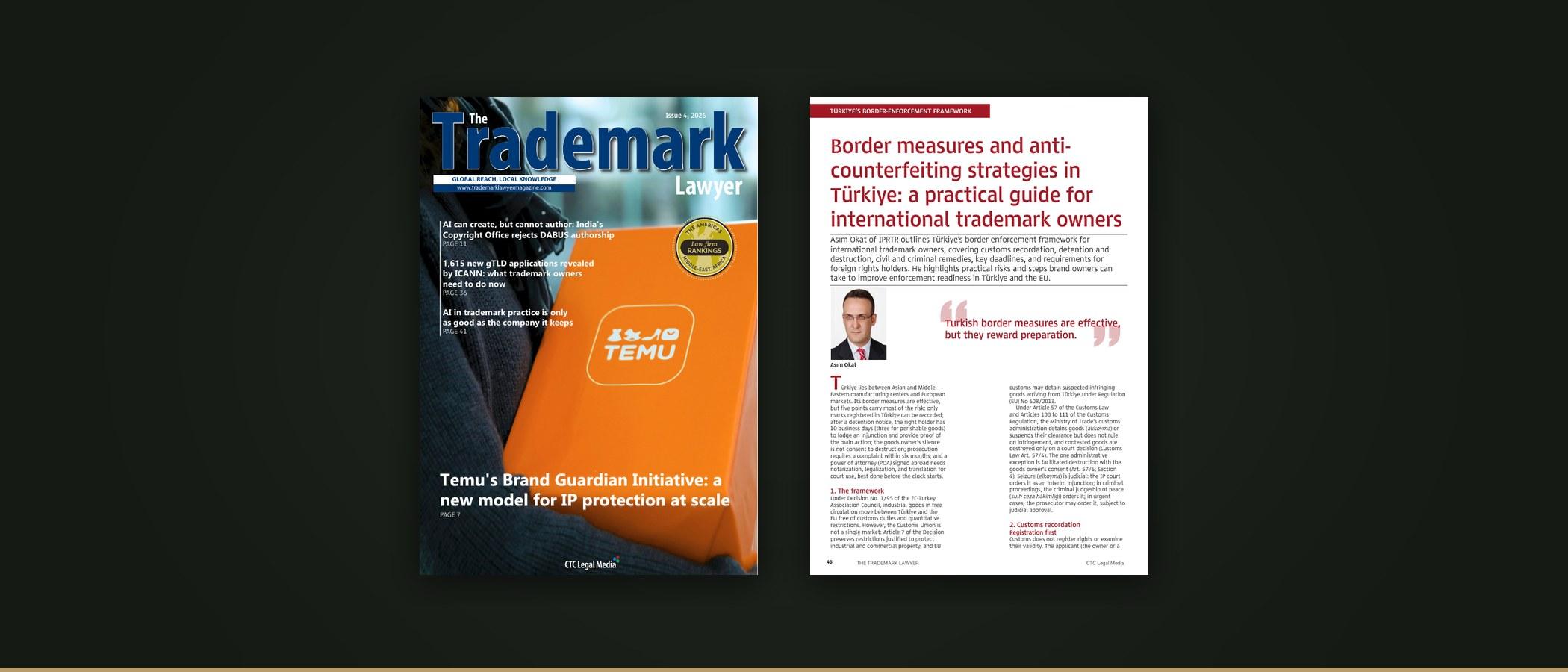
Our founder Asım Okat's article, "Border measures and anti-counterfeiting strategies in Türkiye: a practical guide for international trademark owners", appears on pages 46–49 of The Trademark Lawyer, Issue 4 2026, published by CTC Legal Media. The magazine has provided a branded PDF of the feature for our readers.
Read the article (PDF) · Browse the full issue online
Why the article was written
Türkiye lies between Asian and Middle Eastern manufacturing centres and European markets, so goods moving through its ports and airports are a natural focus of brand owners' enforcement programmes. Turkish border measures are effective, but they reward preparation. Five points carry most of the risk for foreign right holders:
- only marks registered in Türkiye can be recorded with customs;
- after a detention notice the right holder has 10 business days (three for perishable goods) to obtain a preliminary injunction and prove that the main action has been filed;
- the goods owner's silence is not consent to destruction;
- criminal prosecution requires a complaint within six months; and
- a power of attorney signed abroad needs notarization, legalization and translation before it can be used in court.
What the article covers
1. The legal framework. How the EU–Türkiye Customs Union (Decision No. 1/95) preserves intellectual property restrictions at the border, and how Article 57 of the Customs Law and Articles 100 to 111 of the Customs Regulation divide the work between customs, which detains goods, and the IP courts, which order seizure and destruction.
2. Customs recordation. Who may apply, what the electronic application must contain, the 30-business-day decision period, the one-year validity and the costs the right holder bears, including testing, storage and facilitated destruction.
3. Border measures in action. The notice that starts the clock, inspection and sampling, the limits on using consignor and consignee data, goods outside the regime (personal effects, parallel imports and licence overruns), the divided case law on goods in transit, and ex officio action by customs officers.
4. The 10-business-day window. The deadlines under Article 57/3 of the Customs Law and Article 107 of the Regulation, the extension available for a justified excuse, and facilitated destruction with the declarant's written consent. Unlike the EU regime, Turkish law has no deemed consent and no small-consignment procedure.
5. Formalities for foreign owners. The documents that most often decide a case: a notarized and apostilled power of attorney with a Turkish translation, the special powers required by Article 74 of the Code of Civil Procedure, express authority to file and withdraw criminal complaints, corporate authority certificates, security for costs for foreign plaintiffs, and the urgent-relief route under Article 77/1 when the power of attorney cannot arrive in time.
6. Criminal enforcement. Trademark counterfeiting under Article 30 of the Industrial Property Code: the six-month complaint period, mandatory reconciliation before indictment, seizure orders by the criminal judgeship of peace, and rapid destruction of seized goods under Article 163.
7. Recommendations. Four practical steps: audit registrations, keep the customs application current, prepare the documents in advance, and mirror the Turkish recordation with an EU-wide application under Regulation (EU) No 608/2013.
Key takeaways for brand owners
- Register the core marks, logos and sub-brands with TÜRKPATENT in all relevant classes before counterfeits appear. Pending applications and unregistered marks, even well-known ones, cannot be recorded with customs.
- Keep the customs recordation current and request its extension well before it expires. Outdated partner lists and identification guides are the right holder's responsibility.
- Keep a notarized, legalized and translated power of attorney, with the special powers and criminal-complaint authority, together with corporate authority certificates, on file with Turkish counsel. The 10-business-day clock does not wait for an apostille.
- A Turkish recordation has no effect at EU borders. EU trademark owners should file a Union application as well.
About the publication
The Trademark Lawyer is published by CTC Legal Media and read by trademark practitioners and in-house counsel worldwide. The article is reproduced here as the publisher's branded PDF, with its permission.
If you would like to discuss customs recordation or an ongoing detention in Türkiye, contact IPRTR.